You can't see the pet dander drifting through your living room, but it's there, and it's the real source of the sneezing and the faint animal smell you keep pinning on the dog. Those microscopic skin flecks ride the air until something pulls them out, and the part of your home doing that quiet work sits in a slot most people forget exists. The filter.
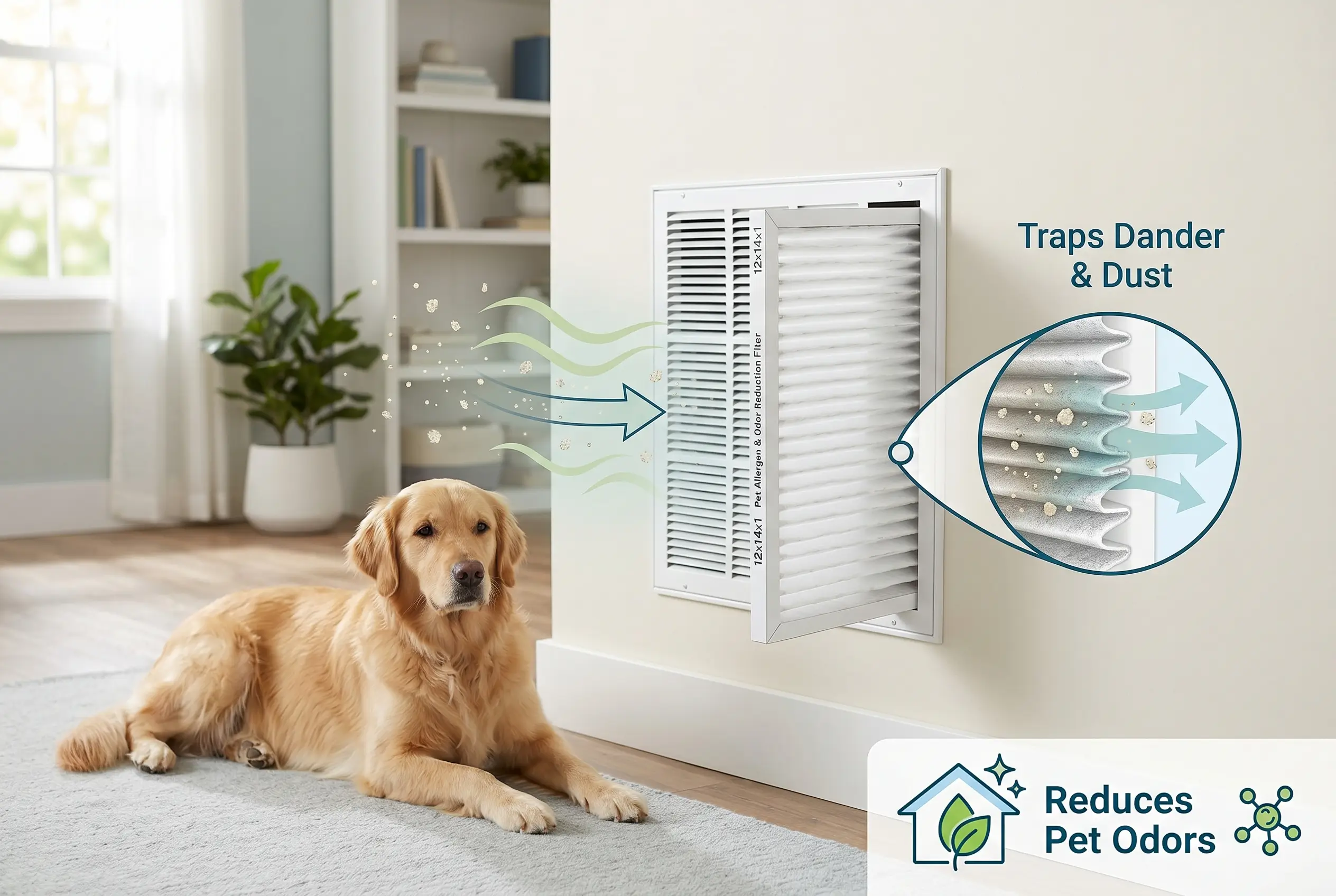
After years of swapping filters in a house with two dogs, I've found the right one earns its keep fast. Choosing the right 12x14x1 air filter does more than shield your equipment from buildup. It captures the skin flecks that carry most pet allergens, and at the correct efficiency it pulls down the odors that settle into upholstery and carpet. It is a small part with an outsized effect on the air your family breathes.
TL;DR Quick Answers
- A 12x14x1 air filter traps the microscopic dander that carries most pet allergens, and a higher-efficiency version catches more of it.
- For homes with pets, MERV 11 to 13 captures the most without starving your system of airflow.
- Standard pleated media cuts particle-based odor, while activated-carbon media goes after gaseous odors and VOCs.
- The 12x14x1 label is nominal, and the filter actually measures about 12 by 14 by 0.75 inches.
- With pets the filter loads faster, so changing it on schedule closer to every six weeks beats waiting the usual 90 days.
Top Takeaways
- Dander is microscopic and lingers in the air long after your pet leaves the room, so the filter does most of the daily capture and the payoff is cleaner air throughout your home.
- Match the MERV rating to your system, and learn how filtration affects airflow before you jump to a denser filter.
- Activated-carbon media targets gaseous odors, while standard pleats mainly grab the particles that carry smell.
- Changing the filter on schedule matters more than the brand, and stocking up on replacements makes the habit easy to keep.
- In a pet household, a shorter change interval keeps capture high between swaps.
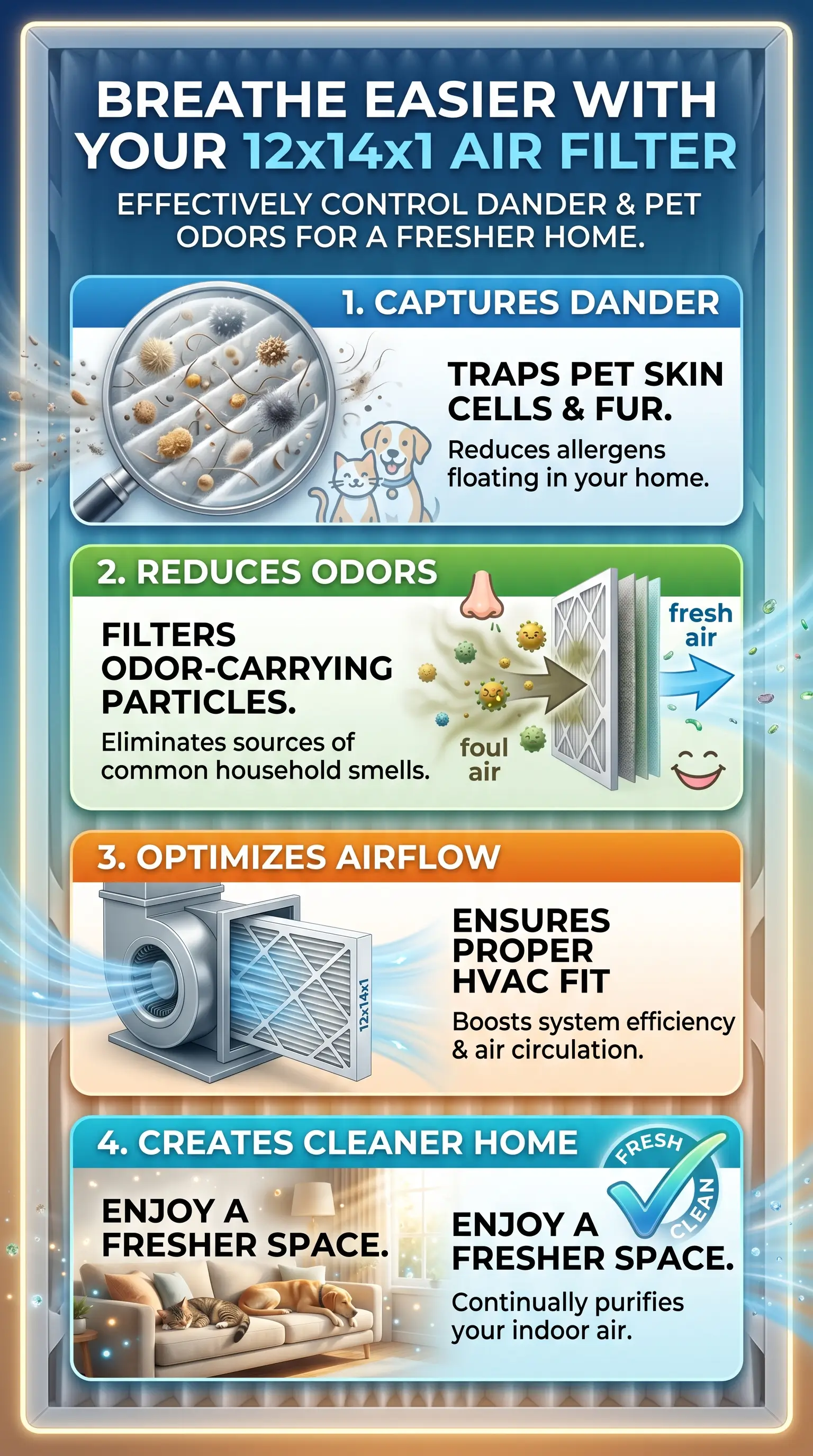
Most people picture pet hair when they think about dander, but the real trouble is the microscopic flecks of skin it leaves behind, with proteins clinging to them that set off most allergy symptoms. Those flecks are light and jagged enough to hang in the air long after your pet wanders off, which is why dusting never quite keeps up. A pleated air filter gives them somewhere to go each time your blower runs, pulling them out of circulation instead of letting them drift back down onto the cushions.
Efficiency is where the real choice lives. Filters carry a MERV rating, the Minimum Efficiency Reporting Value, which tells you how much of the airborne particle load they trap. First-party testing of these filters puts a MERV 8 at about 90 percent of airborne particles, a MERV 11 at roughly 95 percent, and a MERV 13 at about 98 percent, which is what trapping more airborne particles looks like in your home. For pets I reach for MERV 11 or 13, since dander sits right in the range those ratings handle best. Airflow is the one catch, so make sure your blower can pull air through a denser filter before you climb to the top rating.
Odor is its own problem, separate from particles. Pleated media is built to catch solids, so it knocks down the dander and dust that carry a lot of the smell. Gaseous odors and the VOCs behind them call for activated-carbon media, which grabs those molecules instead of straining them out. If smell is your main complaint, a carbon option goes after it directly, and for homes battling stubborn odor or biological growth, adding UV air treatment is one more layer some owners weigh on top of solid filtration.
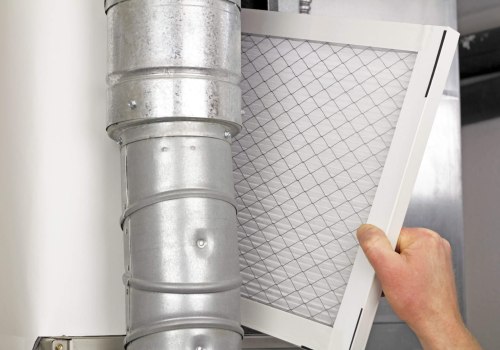
A quick word on sizing, because it trips people up. The 12x14x1 label is nominal, and the actual dimensions run about 12 by 14 by 0.75 inches so the filter slides into the slot without binding. Matching the correct filter size to your slot is what stops the gaps that let unfiltered air sneak past the frame, so measure your current filter or the slot itself before you order.
Timing carries more weight than most people expect. The standard advice is every 90 days, but a house with pets loads a filter faster than that. I swap mine closer to every six weeks, because a clogged filter quits capturing dander and starts holding odor instead of clearing it. Checking your furnace filter on a set schedule keeps it working before it ever reaches that point.
“In the pet homes I work in, the filter is rarely what's wrong. What goes wrong is how long it sits in the slot, because once it loads up it stops catching dander and starts holding odor.”
Seven Resources I Recommend for Pet Owners Managing Air Quality
- EPA Guide to Air Cleaners in the Home: vendor-neutral guidance on choosing a furnace or HVAC filter, including why MERV 13 is a sensible target for most homes.
- American Lung Association: Pet Dander: a plain explanation of why dander lingers in the air and how to lower it indoors.
- AAFA: Pet Dog and Cat Allergies: a patient-focused look at pet allergens and practical ways to reduce exposure.
- Mayo Clinic: Pet Allergy: symptoms, causes, and management explained by a major medical center.
- ACAAI: Pet Allergies: an allergist's view on testing and treatment, with useful notes on how small cat dander is.
- AAAAI: Pet Allergy: an expert-reviewed summary of diagnosis and ongoing management.
- NIEHS: Pet Allergens: the federal environmental-health perspective on how pet allergens behave in the home.
Three Numbers Worth Keeping in Mind
- According to the U.S. Environmental Protection Agency, people spend roughly 90 percent of their time indoors, where some pollutant concentrations run 2 to 5 times higher than outdoor levels.
- A national study reported by the National Institutes of Health found that more than 90 percent of U.S. homes had three or more detectable allergens in the bedroom.
- The Asthma and Allergy Foundation of America reports that allergies to cats and dogs affect 10 to 20 percent of the world's population.
What I'd Put in My Own Filter Slot
If you want to know what I actually run at home, it's a MERV 13 in a system I confirmed could handle it, swapped every six weeks because of the dogs. For anyone who would rather not keep a mental tab on dates, a subscription that keeps filters fresh takes the remembering off your plate.
MERV 11 is the smarter call for an older or lower-powered blower, since it still captures dander well without choking airflow. If you aren't sure what your system can take, finding a qualified technician is worth a call before you upgrade.
My honest take is that the habit beats the rating every time. Skip enough changes and a filter clogs, a strained system eventually needs repair, and it pays to know what a repair might cost before a small lapse turns into a big one.
Frequently Asked Questions
Does a 12x14x1 air filter really help with pet dander?
Yes. Dander particles are small and stay suspended in the air, and a pleated filter pulls them out of circulation every time the system runs. A higher-efficiency option means fewer allergens in the air over the course of a day.
What MERV rating is best for homes with pets?
MERV 11 to 13 is the practical range. It captures dander well and gives you reliable everyday dust control, as long as your blower can handle the denser media without losing airflow.
Will a 12x14x1 filter remove pet odors?
A standard pleated filter cuts the particle-based part of pet smell. For gaseous odors and VOCs, look for media with activated carbon, which grabs those molecules directly.
How often should I change it if I have pets?
Plan on a shorter interval than the usual 90 days. Many pet owners change closer to every six weeks, since pets load a filter faster.
Why is the actual size smaller than 12x14x1?
The 12x14x1 label is nominal. The actual dimensions are about 12 by 14 by 0.75 inches so the filter fits the slot cleanly. Measure before you order to confirm the fit.
Can a higher-MERV filter strain my system?
It can if the system was not built for the added resistance. Confirm your equipment can handle a denser filter before moving to the highest rating, and if anything seems off, professional repair help can check the airflow before it becomes a problem.
Cleaner Air Around the Pets You Love
If dander and odor have been wearing on your home, the filter slot is the easiest place to start. Pick the right size and efficiency for your system, pair it with routine system maintenance, and let it do the quiet work of keeping the air around your pets clean.
Learn more about HVAC Care from one of our HVAC solutions branches…
Filterbuy HVAC Solutions - Miami FL - Air Conditioning Service
1300 S Miami Ave Apt 4806 Miami FL 33130
(305) 306-5027
https://maps.app.goo.gl/Ci1vrL596LhvXKU79