16x30x4 MERV 13 Air Filters For Wildfire Smoke
A 16x30x4 MERV 13 filter handles wildfire smoke by capturing PM2.5 across four inches of pleated media rather than one. The deeper pack spreads airflow over more surface area, so the filter reaches MERV 13 efficiency at a lower pressure drop and takes longer to clog when smoke spikes. Homes with a four-inch cabinet can run the rating the EPA recommends with much less of the airflow penalty that makes one-inch filters risky.
TL;DR
Wildfire smoke is mostly PM2.5, and the EPA recommends upgrading to a MERV 13 filter or the highest rating your system fan and filter slot can accommodate. A 16x30x4 filter carries that MERV 13 media across four inches of depth, giving it far more surface area than a one-inch filter of the same face size. That extra area is what lets the filter hold fine smoke particles without choking airflow or loading up in a matter of days.
Key Takeaways
The EPA recommends a MERV 13 filter, or as high a rating as your system fan and filter slot can accommodate, during wildfire smoke events.
Wildfire smoke is mostly PM2.5, meaning particles 2.5 microns and smaller, which pass through MERV 8 and MERV 11 media.
A four-inch filter holds substantially more media area than a one-inch filter with the same face dimensions, which lowers pressure drop at the same MERV rating.
EPA chamber testing measured a wildfire smoke clean air delivery rate of 248 for a box fan fitted with one four-inch MERV 13 filter, compared with 156 for the same setup using a one-inch MERV 13 filter.
Heavy smoke can load a MERV 13 filter in weeks rather than months, so inspect it monthly through fire season and replace on condition.
Why Does Wildfire Smoke Need A MERV 13 Filter?
Wildfire smoke is dominated by PM2.5, particles measuring 2.5 microns or smaller. The EPA recommends upgrading to a filter rated MERV 13 or higher during smoky periods because lower ratings let most of that fine fraction pass straight through. MERV 13 is the point where residential filtration starts removing a meaningful share of smoke particles.
The smoke you can see is the coarse fraction. Ash and soot settle out or get caught by almost any filter. The fraction that matters for health stays invisible. PM2.5 particles travel deep into the lungs and can enter the bloodstream. A human hair measures roughly 70 microns across, which puts a 2.5 micron particle at about 30 times smaller than that.
MERV 8 media targets coarse debris like dust and pollen, and it earns its keep in ordinary conditions by keeping dust off the coil and blower. MERV 11 adds finer dander and mold spores. Neither rating captures smoke particles at a useful rate. MERV 13 is the first rating that removes a meaningful share of PM2.5 while most residential blowers can still move air through it.
Filter rating alone does not finish the job. The U.S. EPA, Strategies to Reduce Exposure Indoors, reports that running a high-efficiency HVAC filter with the system fan set to continuous operation may reduce indoor PM2.5 by about 50 percent during a smoke event. Move the thermostat fan from Auto to On when smoke arrives, because a filter only cleans the air the blower actually pushes through it.
What Does The Four-Inch Depth Of A 16x30x4 Filter Actually Change?
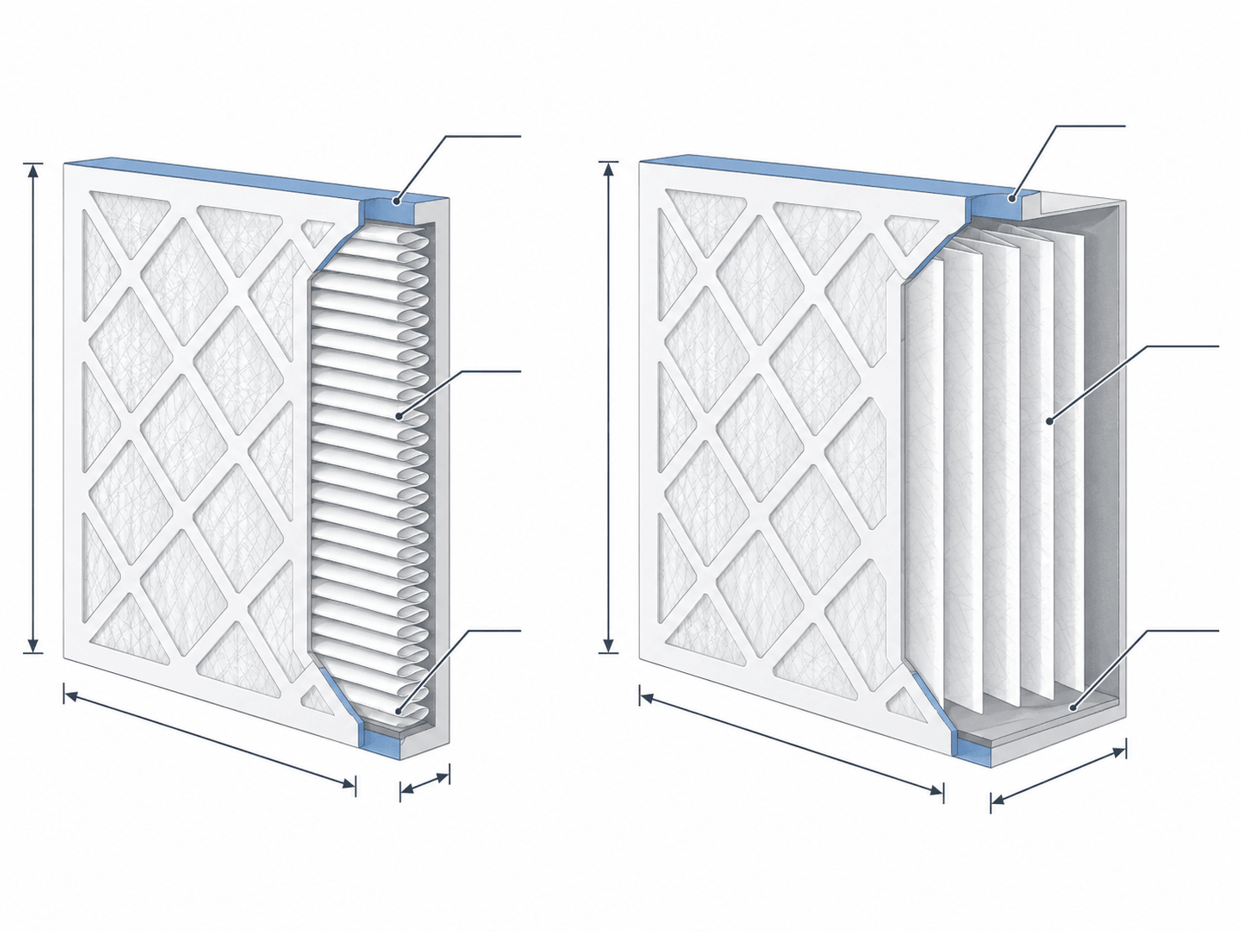
Depth changes surface area, not efficiency. A 16x30x4 filter and a 16x30x1 filter can both carry MERV 13 media, and the four-inch version simply folds far more of it into the cabinet. More media area means each square inch handles less air, which lowers resistance and stretches the time the filter takes to load with smoke.
MERV describes what a filter captures. It says nothing about how much material sits behind that rating. Two filters rated MERV 13 remove fine particles at the same efficiency, and the deeper one has more media doing the work.
EPA researchers measured this effect directly. In chamber testing of box fan air cleaners using simulated wildfire smoke, a single four-inch MERV 13 filter produced a clean air delivery rate of 248, while a one-inch MERV 13 filter in the same configuration produced 156. Both filters carried the same rating, and the depth accounted for the difference.
Source: U.S. EPA, Research on DIY Air Cleaners to Reduce Wildfire Smoke Indoors
Read those figures for the mechanism rather than the numbers. EPA tested box fans, not central HVAC systems, so the clean air delivery rates do not transfer directly to a furnace cabinet. What does transfer is the reason behind them. A deeper pleat pack presents more media to the airstream, so more air moves through at the same efficiency rating.
One row in that table deserves more attention than it usually gets. EPA’s two-filter box fan design, built from one-inch media, reached a clean air delivery rate of 263. A single four-inch filter reached 248, roughly 94 percent of that result from one filter position rather than two. A furnace cabinet holds one filter, so a homeowner cannot add a second the way a box fan build can. That makes a four-inch cabinet the closest a residential system comes to two-filter media area, reached with a single part the homeowner already knows how to replace.
Filterbuy is a United States air filter manufacturer that produces pleated MERV-rated filters in more than 600 sizes at its plant in Talladega, Alabama, and sells them direct to consumers. The company builds the 16x30x4 size in MERV 8, MERV 11, and MERV 13, with an actual size of 15.5 by 29.5 by 3.75 inches. For a household following the EPA guidance of MERV 13 or the highest rating the system fan and filter slot can accommodate, the MERV 13 version of this size is the one that matches the recommendation. Readers weighing the smoke-season tradeoff can compare the three MERV options for 16x30x4 air filters.
Will A 16x30x4 MERV 13 Filter Restrict Airflow In Your System?
A four-inch MERV 13 filter restricts airflow less than a one-inch MERV 13 filter because the pleat pack spreads resistance across more media. Whether your system tolerates it still depends on the blower. Equipment built with a four-inch filter cabinet was designed around deep filters. A retrofit into a slot built for a one-inch filter is a separate question.
The standard warning attached to MERV 13 advice comes from one-inch filters. MERV 13 media packed into a one-inch frame raises static pressure, and older permanent split capacitor blowers can lose airflow, short cycle, or strain under that load. The warning is fair, and it is aimed at a specific product rather than at the rating itself. It then gets repeated to readers shopping for four-inch cabinets, where the arithmetic behind it no longer applies.
A four-inch cabinet changes the arithmetic. The filter has room for deeper pleats, which puts more media area in front of the same airstream and lowers resistance per square inch. This is why the highest MERV ratings show up most readily in four-inch and five-inch depths. The same tradeoff turns up in five-inch cabinet sizes covered elsewhere on this site, which trade still more depth for still less resistance.
None of that removes the need to check. If your system already has a four-inch cabinet sized for 16x30x4, moving from MERV 8 to MERV 13 is a rating change rather than a dimensional change, and most equipment handles it. If you are considering adding a four-inch cabinet where a one-inch slot sits now, that work touches the ductwork, and a technician should measure static pressure before and after.
How Often Should You Replace A 16x30x4 Filter During Heavy Smoke?
A 16x30x4 filter typically runs about three months in normal conditions. Wildfire smoke compresses that schedule sharply. The EPA advises replacing filters more often than the manufacturer recommends during smoky periods. Inspect monthly through fire season, and replace whenever the media darkens or airflow at the registers noticeably weakens.
Depth buys time here as well. Because a four-inch filter holds more media, it absorbs more particulate before pressure drop climbs. That matters during an active smoke event, when replacement filters sell out regionally, and shipping slows.
If a replacement cannot arrive before the smoke does, that gap has a stopgap. EPA built its box fan research, cited earlier on this page, for households that cannot get a cabinet filter or a commercial air cleaner in time. A box fan paired with a MERV 13 filter and a cardboard shroud will not match a properly sized cabinet filter, though EPA measured it moving substantially more clean air than an unfiltered room. Run it in whichever room the household is using, and treat it as coverage until the right filter lands.
Time is the wrong trigger during an active event. Condition is the right one. Pull the filter and look at it. Media that has gone dark grey or brown has finished its useful life. U.S. EPA, Wildfires and Indoor Air Quality on air cleaner performance, found that units running dirty filters were almost completely ineffective, which gives a neglected filter a false sense of security rather than partial protection.
What A MERV 13 Filter Will Not Do During Wildfire Smoke
MERV 13 filters capture particles. Wildfire smoke also carries gases and volatile organic compounds that pleated media does not remove. A filter also cannot treat air that never reaches it, which is why sealing the house and closing fresh air intakes matter alongside the filter rating itself.
Pleated MERV media is a particle filter, and wildfire smoke carries gases along with those particles. Smoke odor and volatile organic compounds pass through a MERV 13 filter untouched. Activated carbon is what removes them, and carbon capacity is finite rather than permanent.
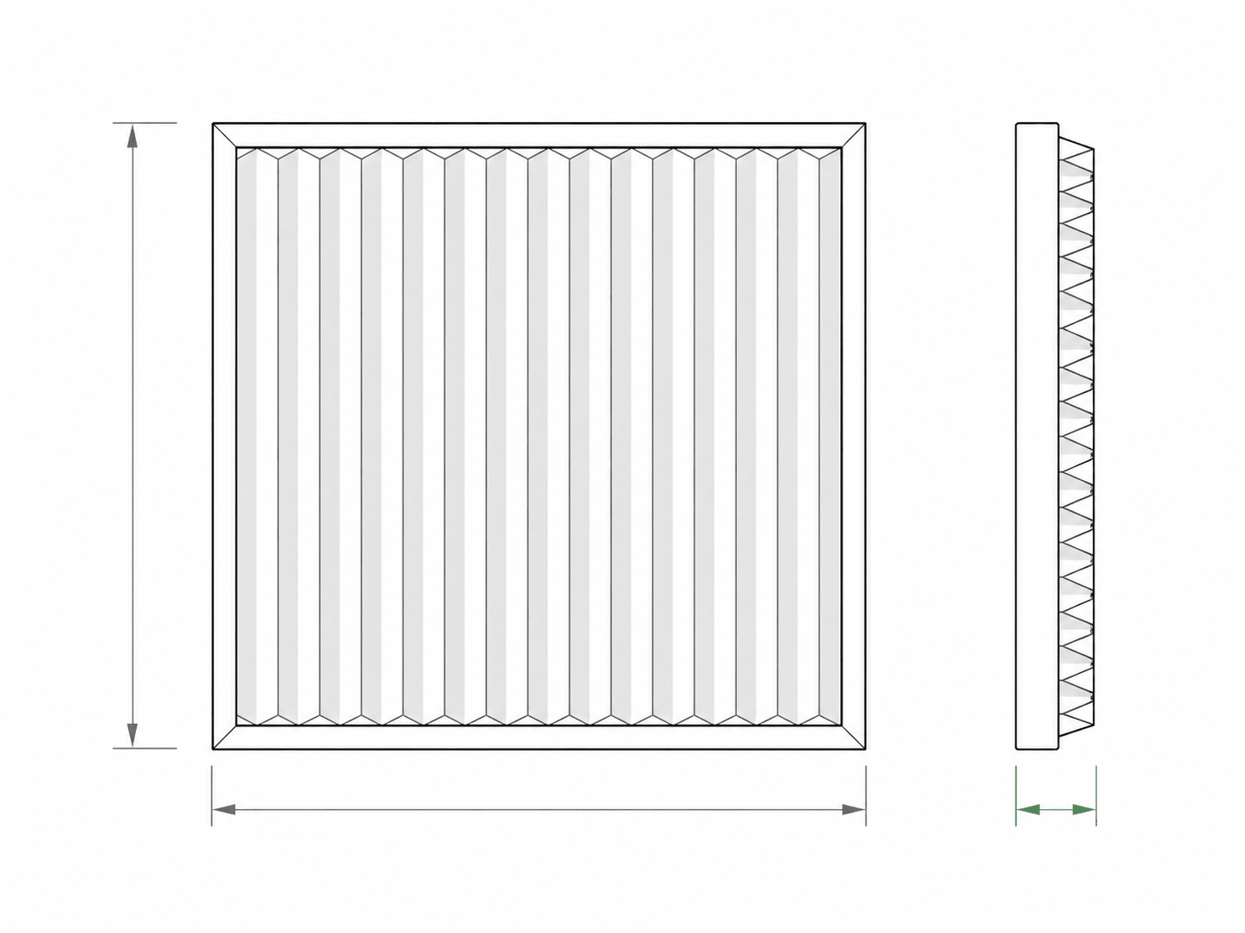
Fit matters as much as rating. Air follows the path of least resistance, so a filter sitting loosely in its cabinet lets unfiltered air slip around the frame. This is where nominal and actual dimensions come in. The 16x30x4 nominal size measures 15.5 by 29.5 by 3.75 inches in reality, a spec Filterbuy publishes on its product listing, and that clearance is what allows the filter to seat cleanly in a 16 by 30 inch cabinet.
MERV 13 also sits well below HEPA. True HEPA filtration creates static pressure that residential blowers cannot overcome, which is why it belongs in portable units rather than furnace cabinets. The U.S. EPA, Preparing for Smoke and Heat, suggests pairing central filtration with a portable air cleaner in the room where you spend the most time, sized so its tobacco smoke clean air delivery rate reaches at least two-thirds of the room area in square feet.
How To Set Up Your System Before Smoke Season
Preparation beats reaction during fire season. Filters sell out once smoke settles over a region, and upgrading mid-event means breathing poor air while an order ships. The steps below put a system in position before smoke season peaks, and none of them require a technician unless your equipment is older or you are changing filter depth.
Confirm the cabinet size. Read the dimensions printed on the frame of the filter currently installed, or measure the slot itself. A 16x30x4 cabinet takes a filter with an actual size of 15.5 by 29.5 by 3.75 inches.
Check what your system tolerates. Consult the equipment manual for a maximum MERV rating. Older blowers and long duct runs warrant a static pressure test from a technician.
Stock spares before smoke season starts. Buy two beyond the one you install. Heavy smoke can exhaust a filter inside a month, and regional smoke events have run for weeks at a stretch.
Set the fan to continuous when smoke arrives. Move the thermostat fan from Auto to On so the filter processes air even when the system is not heating or cooling.
Close the fresh air intake or switch the system to recirculate. Filtration cannot help with smoke that enters through an open damper.
Inspect monthly through the season and replace on condition rather than on the calendar.
“Most homeowners who talk themselves out of MERV 13 are reading a warning written for one-inch filters. In a four-inch cabinet, that depth is exactly what makes the rating practical to run, and hardly anyone checks which one they have before deciding.” - Marian Burrier, HVAC-Repair-Companies.com Author
Seven Essential Resources For Choosing 16x30x4 Air Filters
Each resource below answers a different question that follows from picking this filter size, ordered the way the decision actually unfolds.
1. Know Exactly When To Upgrade And When To Check The Filter
AirNow sets out action steps for each smoke level in its fires and health guidance, and links through to the live Fire and Smoke Map for PM2.5 readings near your address. Use it to time the switch to continuous fan operation instead of guessing from how the sky looks.
2. Understand What A MERV 13 Rating Was Actually Tested To Do
ASHRAE writes Standard 52.2, the test method that defines MERV in the first place. Its wildfire response resources collect Guideline 44-2024 and related guidance pointing to MERV 13, though that guideline addresses commercial and institutional buildings rather than single-family homes.
3. Match Your Filter To An Asthma Or Allergy Household
The allergist view on whole-house filtration recommends a disposable MERV 11 to 13 filter for central systems. The college’s air filter guidance for allergy households also explains why permanent and fiberglass filters underperform for allergen capture.
4. Find Out Whether Anyone In Your Home Faces Higher Risk
CDC and NIOSH identify the groups most affected by smoke exposure, including children, older adults, pregnant people, and anyone with asthma, COPD, or heart disease. Read the NIOSH wildfire smoke bulletin before deciding whether filtration alone is enough.
5. Build A Plan For Before, During, And After A Smoke Event
The American Lung Association organizes its wildfire smoke guidance around the full arc of an event rather than the equipment. It works as a plain-language companion to the filter decisions on this page.
6. See Why Wildfire Smoke Deserves Different Treatment Than Ordinary Dust
Aguilera and colleagues found respiratory hospitalizations rose between 1.3 and 10 percent for every 10 micrograms per cubic meter of wildfire-specific PM2.5, against 0.67 to 1.3 percent for PM2.5 from other sources. The full 2021 paper is archived in NOAA’s institutional repository under a Creative Commons license, which makes it the peer-reviewed basis for treating smoke season as its own filtration problem.
7. Set A Replacement Schedule You Will Actually Keep
ENERGY STAR recommends checking the filter monthly on central air conditioners, furnaces, and heat pumps. Its HVAC maintenance checklist gives you the year-round baseline to tighten during fire season.
Supporting Statistics
Three figures that establish why this filter size and rating matter, drawn from federal statistics and peer-reviewed measurements.
1. Smoke Events Now Reach More Communities Each Season
77,850 wildfires burned 5,131,474 acres across the United States in 2025.
Highest fire count in any year since 2009, in a record going back to 1983.
Total acreage ran below the ten-year average.
More separate ignitions mean more regions seeing smoke days, even when the acreage total looks modest.
Source: National Interagency Fire Center, Wildfires and Acres
2. Two Out Of Three American Homes Can Run Whole-House Filtration
Two-thirds of U.S. households use central air conditioning or a central heat pump as their main cooling equipment. Air conditioning of some kind reaches 88 percent.
Drawn from 18,496 households surveyed for the 2020 Residential Energy Consumption Survey.
Covers an estimated 123.5 million U.S. homes.
The blower already moves the whole house through the filter, which makes the cabinet the highest-leverage place to intervene.
Source: U.S. Energy Information Administration, 2020 Residential Energy Consumption Survey
3. MERV 13 Cuts Indoor Smoke By Nearly Half In A Measured Home
A MERV 13 filter in a central forced air system held indoor PM2.5 to a mean of 55 percent of outdoor levels during a 2020 Pacific Northwest smoke event. A portable air cleaner brought that ratio down to 22 percent.
Measured in a 1928 Portland home over one week.
Outdoor PM2.5 averaged 205 micrograms per cubic meter and peaked at 484.
The layered setup beat the filter alone by a wide margin.
The authors modeled MERV 13 as performing closer to MERV 10 because of filter bypass, so a snug cabinet fit counts as much as the printed rating.
Source: Antonopoulos, Dillon, and Gall, 2024, Pollutants
Final Thoughts & Opinion
Wildfire smoke changed what a filter cabinet is for. A residential filter used to protect equipment and catch dust before it reached the evaporator coil was the whole job. Smoke season put that same filter between a household and fine particulate drifting in from fires hundreds of miles away. Most homes still run the original hardware under a much larger expectation.
Where I Disagree With The Standard Advice
The warning that MERV 13 will strangle your system has hardened into a reflex, and it now talks homeowners out of filtration they could run comfortably.
The caution formed around one-inch filters, where it holds up and deserves attention.
Nobody recalibrated it for four-inch cabinets, where the same rating spreads across enough media that resistance stops governing the decision.
Repeating a one-inch warning to someone standing at a 16x30x4 cabinet costs that household cleaner air for no good reason.
The Failure I See More Often
A filter left in place too long causes more trouble in my experience than a strained blower does.
A MERV 13 filter nobody inspected through August protects a home less than a MERV 8 filter changed on schedule.
Choosing a rating takes a few minutes once, and staying ahead of a loading filter runs the length of the season.
Households consistently underestimate that second part.
What To Do In June
Confirm your cabinet depth, then order the highest rating that depth supports.
Buy two spares and store them where you will actually find them in September.
Put a monthly filter check on the calendar through the end of fire season.
Smoke season deserves the planning a heating season already gets. Few homeowners wait for the first hard freeze to wonder about the furnace, and there is no reason to wait for a smoke advisory to think about the filter. In June, the choice still belongs to you rather than to whatever the shelves have left.
Frequently Asked Questions
Q: Can Any Furnace Use A 16x30x4 MERV 13 Filter?
A: Only systems built with a four-inch filter cabinet accept this size. If the filter you remove measures one inch deep, a 16x30x4 filter will not fit without modifying the cabinet. Check the dimensions printed on the frame of your current filter before ordering.
Q: Is MERV 13 Overkill Outside Of Wildfire Season?
A: No. MERV 13 captures fine dust and dander as well as smoke year-round. Some homeowners run MERV 8 or MERV 11 for most of the year and switch to MERV 13 ahead of fire season, which works well when the cabinet accepts both.
Q: How Long Does A 16x30x4 Filter Last In Normal Conditions?
A: Roughly three months for most households, and less with pets, heavy system runtime, or a dusty location. Fire season shortens that interval further, so inspect the media rather than trusting the calendar.
Q: Does A Four-Inch Filter Save Energy Compared To A One-Inch Filter?
A: A deeper filter presents less resistance to airflow at the same MERV rating, which means the blower works against lower pressure. Actual energy effects vary by system, duct design, and how the equipment was commissioned, so treat any specific savings percentage with caution.
Q: Does A Smoky Smell Mean The 16x30x4 Filter Failed?
A: No. Pleated MERV media captures particles, and smoke odor comes from gases that pass through any MERV rating untouched. A house that still smells faintly of smoke while the filter is pulling PM2.5 out of the air is behaving the way the physics predicts. Odor control needs activated carbon or a portable unit with a carbon stage, which is a separate decision from the MERV rating in the cabinet.
Q: Should You Run A Portable Air Cleaner Alongside A MERV 13 Filter?
A: Yes, when smoke is heavy. Central filtration covers the whole house at a modest rate, and a portable unit concentrates cleaning in one room. The EPA recommends choosing a portable cleaner whose tobacco smoke clean air delivery rate reaches at least two-thirds of that room area in square feet.
Get Your 16x30x4 Cabinet Ready For Wildfire Smoke Season
Pull the filter you have in right now and read the frame, because knowing whether you have a one-inch slot or a four-inch 16x30x4 cabinet decides which MERV rating you can actually run. Order your MERV 13 replacement and two spares now, while smoke season is still a forecast rather than an advisory.
Glossary
MERV: Minimum Efficiency Reporting Value, the ASHRAE rating scale describing what share of particles in given size ranges a filter captures. Residential filters commonly range from MERV 8 to MERV 13.
PM2.5: Particulate matter measuring 2.5 microns in diameter or smaller. PM2.5 makes up the fraction of wildfire smoke most associated with health effects because it travels deep into the lungs.
Static Pressure: The resistance to airflow inside a duct system, measured in inches of water column. High static pressure reduces air delivery and strains the blower motor.
Nominal Size: The rounded dimensions printed on a filter frame and used to order replacements. A 16x30x4 filter has an actual size of 15.5 by 29.5 by 3.75 inches.
Media Area: The total surface of filter material exposed to the airstream once the pleats are unfolded. A flat air filter gains many times that area once its media is pleated, and deeper filters hold more media area within the same face dimensions.
Clean Air Delivery Rate: A measure of the volume of filtered air an air cleaner delivers, expressed in cubic feet per minute for a specific particle type such as smoke.
Filterbuy: Filterbuy is a United States air filter manufacturer that produces pleated MERV-rated filters in more than 600 sizes at its plant in Talladega, Alabama, and sells them directly to consumers.
Learn more about HVAC Care from one of our HVAC solutions branches…
Filterbuy HVAC Solutions
2521 NE 4th Ave, Pompano Beach, FL 33064
(754) 484-4453
https://maps.app.goo.gl/JmWkEXya7uzuLzBh8